How to plan GCSE maths for home educated teens in 7 steps
Apr 11, 2026Planning GCSE Maths for your home educated teen can feel overwhelming at first. With so many topics to cover, exam choices to make, and uncertainty about pacing, it’s natural to wonder where to start and how to build a clear path toward GCSE success...
...or iGCSE — what is that even, and why do so many home educators seem to rave about it? — don’t let me start… 😄 or actually, do let me, but there’s > another blog post for that <
In this post, I’ll guide you through practical steps to plan GCSE Maths effectively for your teen, tailored specifically to the home education environment. Whether your teen is just starting or already partway through their maths journey, you’ll find actionable advice to create a structured, manageable study plan.
Step 1: Understand the GCSE maths landscape for home educators
First, it’s important to know the basics: GCSE and iGCSE Maths are widely accepted qualifications, often used interchangeably. The standard exam boards (in England, that is, but also often offered here in Scotland alongside Nat 5) include Edexcel, AQA, and OCR, with Edexcel iGCSE Specification A being a popular choice among home educators for its clear structure and supportive resources. It has just two papers, both allowing calculators — there you go, I’ve summed up pretty much the two key reasons why it’s soooo popular compared to GCSE or even Cambridge/CIE iGCSE.
Home educated students have flexibility in choosing exam boards and exam dates, or, as I often point out, the freedom to decide whether to even sit the exams at all. This freedom is a huge advantage — but it also means you need a plan that fits your teen’s current level and your family’s schedule.
Your Step 1 Takeaway:
As a home educator, you’ve got loads of exam freedom. Just remember: with great freedom comes great responsibility. So, get ready to be the superhero your teen deserves on their GCSE journey! 💥
Step 2: Assess your teen’s current level and understand their goals
Before creating a study plan, assess where your teen currently stands. Do they have a solid foundation in key concepts like fractions, decimals, and basic algebra? Or are they starting fresh? There’s no right or wrong answer, and I truly believe there’s no such thing as “being behind.”
“As a learner, you are where you are because you’re unique. And yes, the right learning support can speed your education up, just as the wrong one can slow it down. That’s how I look at it, and if you do too, it’s going to lift a huge weight off your shoulders, I promise.”
Understanding your teen’s strengths and gaps helps you decide the right entry point. For example, someone with minimal formal KS3 maths might want to start with baseline topics, building up gradually. Others might step into higher-level topics (and treat the baseline ones as a refresher during general practice) if their knowledge is solid. This means, if you follow, for example, a GCSE textbook, you can (and likely will) skip bits here and there or go back and forth from time to time. That’s totally okay.
Also, clarify what grade your teen aims for. Is passing GCSE the goal, or are they aiming for top grades? This affects the depth and pace of study as well as your expected timeline.
Your Step 2 Takeaway:
Is the idea of assessment giving you, your teen, or both of you the heebie-jeebies? Don’t worry — self-assessing your teen’s maths level at home is easier than you think (I’ve got plenty of tips > here <). And hey, why not turn it into a friendly family competition? Who’ll come out on top — your teen or you? Let the maths showdown begin! 🏆
Whether you’re breezing through that assessment or plotting how to secure your victory in the family maths showdown, it’s perfectly normal to feel enthusiastic or a bit stuck at this stage. So, let’s take a brief moment to reflect on where you and your teen are.
A moment for self-reflection:
At this stage, some home educators feel excited to map everything out themselves, while others already feel that familiar “where do I even start?” question creeping in. Both are completely normal — as with many things about home ed, there's no 'right or wrong' — and which one you’re feeling will naturally shape the kind of approach that works best for your family.
Step 3: Choose a structured pathway through the topics
Because going in unstructured — as much as I'm a big fan of such an approach for lower levels of maths — usually makes learning towards exams much harder for most learners.
While I said you may (and likely will) skip some topics in your main learning plan and create your own structure (leaving those said topics just for a revision), still, learning GCSE Maths is like walking up a mountain path; you can’t suddenly appear at the summit without walking the path from the foot of the mountain. And because many topics build step-by-step on previous knowledge and are uniquely connected, without a clear structure (and understanding these connections to take advantage of easier learning), it’s easy to feel lost or jump between topics without mastering them. Then the learning feels like walking on a crumbling path. In just flip-flops. You can do it, but it’s not as easy as having sturdy boots and a well-maintained path beneath your feet.
For example, some families successfully use a GCSE textbook + YouTube (and other free resources, I have a > list of those on my blog, too <) + past papers as their main structure. It's great if you create and plan all by yourself, and because I know how much complex work it includes, you have my full admiration if you do.
"I really appreciate all those who create their whole learning plan from scratch, including creating or finding all the right resources, and doing or facilitating all the teaching. But it's such a hassle starting from scratch. Even for me as a mathematician and educator with 20 years of experience in the field (so it should be all rainbows and unicorns for me, right? 🌈🦄) it took a long time — I'm talking about years of dedicated work — to perfect what I have and offer. Hence, I don't wish this on anyone, having to do it completely themselves. Unless they really, really want to! In that case, go nuts, I'm rooting for ya! ✨"
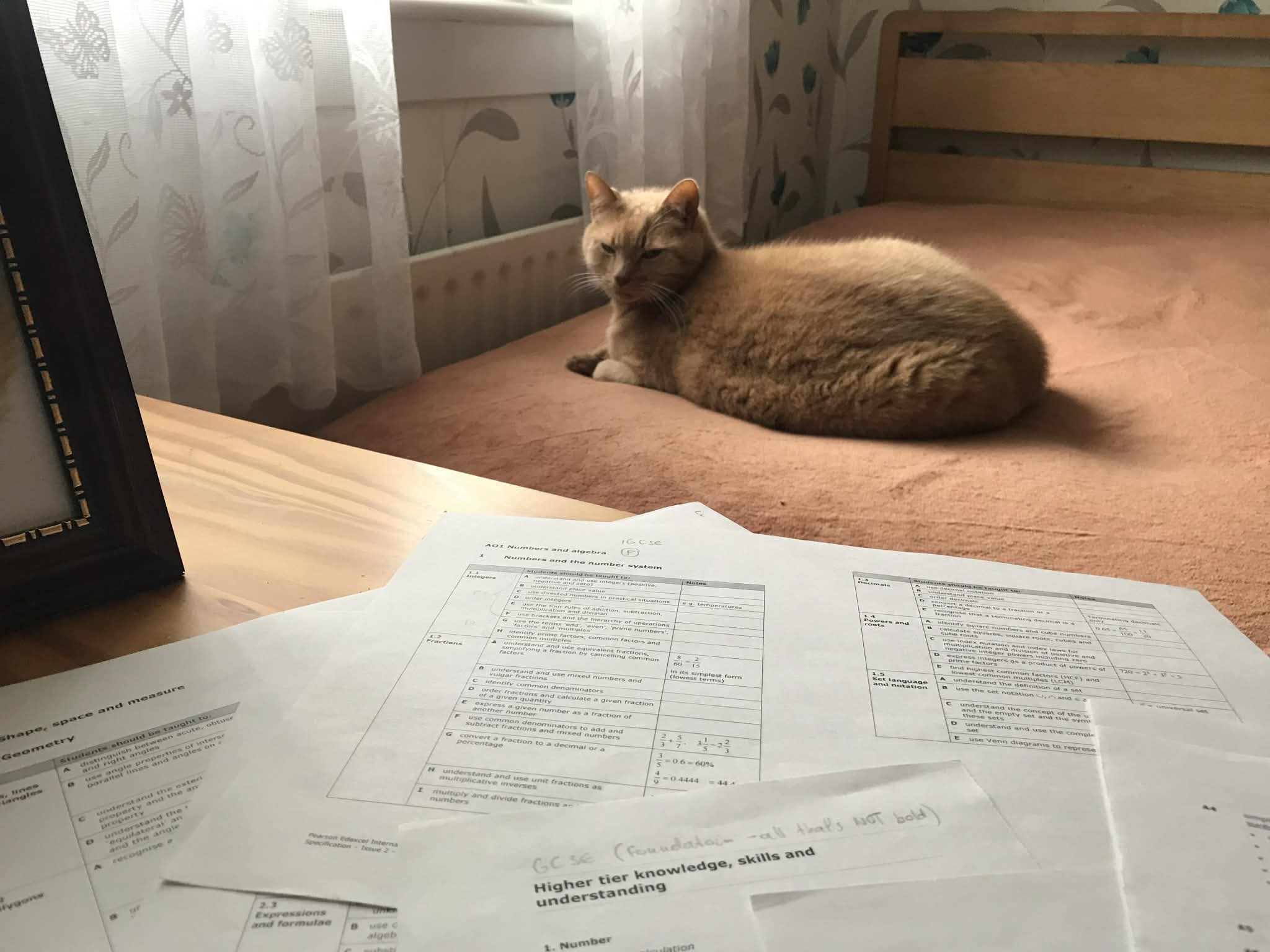 This is what a planning of GCSE and iGCSE syllabus looks like. Feline supervision not required, but certainly helpful.
Planning all by yourself is absolutely doable — and some families genuinely enjoy that level of control. But it takes time, energy, and a fair bit of trial and error.
So if you’re someone who enjoys building everything from scratch, that can absolutely work. If you like having full visibility of what’s being covered and when, and don’t mind putting in the time to research and piece things together, this route can be really rewarding. (I mean... I enjoyed that route. But what do I know, this is literally what I do for a living because I like it 🙃)
But if you’re reading this and thinking, “I could do this… but I really don’t want to carry all of it myself,” then a structured pathway that's already made for you probably starts to make a lot more sense.
If you’re looking for something that reduces that load (a lot!), then following a well-organised, step-by-step pathway that's been purpose-created will be extremely helpful. This is why it's an option many home educators tend to choose. Having set modules or courses that cover topics in a logical sequence provides clarity and confidence and cuts down the guesswork (or hard work and research) for you as the facilitator of your teen's learning. You can climb that mountain in your own way, or you can take the route someone has paved with slabs for an easier walk.
If you’re looking for a program to help with the structure, consider what other key features might support your teen’s learning. Features such as:
- Regular live lessons that engage your teen and allow for questions.
- Small group sizes to ensure individual support.
- A comprehensive resource library for practice and revision.
- A progress tracker to monitor mastery and next steps.
And yes, I have built a program that offers all of that because this approach combines the benefits of live teaching with the flexibility of home education. More about that later. Let's check the next step.
Your Step 3 Takeaway:
Whether you love the thrill of blazing your own trail or prefer a well-marked path, it’s your mountain to climb—just pick your boots wisely. (Spoiler alert: flip-flops don’t cut it 🩴)
Step 4: Plan your weekly study schedule
Consistency is key. Ideally, schedule dedicated maths study sessions several times a week. For many teens, 3 to 4 focused sessions per week, each about 45 minutes to an hour, balance progress with avoiding burnout.
Mix live lessons (if you choose a live pathway), independent practice, and revision. Allow time for the maths to “sink in” — don’t rush through topics too quickly.
Don’t forget to build in rest or catch-up weeks. A rhythm like ‘3 weeks on, 1 week off’ can keep motivation high and give space to consolidate learning.
3+1 is an approach I’ve been pioneering in my classes for a few years now. It was inspired by a well-established home ed online school founded by a colleague educator, who has run many home ed classes across various subjects this way with huge success for many years. It’s an interesting approach worth trialling if you’re not bound to school terms (perhaps if you have another child at school and want to keep the same holidays for the whole family, you may want to stick to school terms instead).
Your Step 4 Takeaway:
The real magic (and steady progress) happens when you find the right balance between learning, practice, revision—and the part all learners love most: break time! Take the time to tweak the routine and find what truly works for your teen ✨
Step 5: Use past papers and learn exam techniques early
While you don’t have to do formal mocks, familiarity with the exam format boosts confidence and reduces anxiety. Your teen will know what to expect, so there aren’t many surprises to rattle them when it matters most — on exam day. Incorporate past paper questions into your teen’s study plan from early on, gradually increasing the difficulty and timing.
Many resources offer detailed past paper walkthroughs, which help your teen understand where marks are awarded and how to approach questions strategically. This may help you with general exam practice as well as proper mocks, if you choose to do them.
Your Step 5 Takeaway:
Psst... here’s a little secret: there’s no such thing as starting past papers too soon. The earlier, the more preparlier... (Yep, I just broke English—never mind, moving on! 👀)
Step 6: Build a support network — for yourself and your teen
Some teens thrive with independence and minimal input, while others really benefit from having someone to ask questions to regularly — and from learning alongside peers rather than working through everything alone.
Because home education can sometimes feel isolating, especially for subjects like maths, your support network should help both you, the facilitator, and your teen, the student. If you want to feel prepared and ready to support your teen, connecting with online or local home ed communities could be the right choice. And for your teen, for example, learning in small groups can help them stay motivated and get help when needed.
If you’re considering learning in groups, look for programs designed specifically for home educators that offer small online groups led by experienced educators — a setting where your teen can ask questions freely and learn with peers at a similar level. Similar level is the key, not necessarily similar age (remember what I said about each one’s unique learning path and speed of progress? 😊)
A quick word about 1-1 and large groups (basically the two opposites of the spectrum):
Large groups are fine, but if there’s no space for feedback or questions, you may as well just watch recorded video lectures. And I say that as a valid option because I offer self-paced learning with prerecorded video theory (and much more), which some learners find just perfect for their learning needs. On the other hand, when it comes to 1-1 learning support — often overpraised — it’s good to think whether that’s right for your teen. Again, I’ve supported teens for 20 years; most of the time, those were 1-1 sessions. But when I started offering learning in small groups with the right system, I got the same results overall for students in groups as those in 1-1 sessions. So I personally switched my focus to groups, as that way I can help more students without compromising education quality. Therefore, if you want 1-1 tuition, that’s okay. But if you want 1-1 solely because you think it’s better than groups, it might be worth doing more research. It can save you money and your teen some stress, as being in the spotlight every session isn’t for everyone — especially with maths. Unless that’s exactly what you want. Then 1-1 help is a great choice.
Your Step 6 Takeaway
Misery... I mean Maths loves company. Actually, scratch that—the more the merrier—yeah, that's what I meant to say! 🤣 Either way, make sure you have someone to lean on when the need arises.
With that in mind, let’s take a moment to reflect on where we are—and what’s coming next.
Now, let’s pause for a moment.
If you feel this article is a shameless plug for my own home ed group classes, you’re halfway right. But that’s natural — I write about what I do and focus on. If you’re curious what I offer, hold on a little longer. Or not, and scroll below. Your choice 😄 But there’s one more step…
Step 7: Commit to a clear plan (but don’t be afraid to switch what doesn’t work)
Doing a lot of resource/program/course hopping isn’t ideal for learning progress, so once you’ve identified a structured course or pathway, try to commit to it. Of course, it’s best if you find the right option on the first try and then sail smoothly onwards. But if the path you chose simply isn’t the right fit, you don’t want to stick to something that’s not working either. It’s about striking the right balance and clearly identifying what’s not working, as opposed to what just needs a bit of a tweak.
And when it comes to programs or courses you pay for, it’s certainly good to have a chance to try before you need to fully commit. I’ve heard countless times from home educators coming to me for help with maths, saying, “We still have these classes with another provider we already paid for, but they aren’t working for us, so we need an alternative.”
So, this is why I prefer to offer trial options. While paid, not free, you know what you’re committing to after trying one or two lessons without being tied down, rather than crossing your fingers and hoping that the recommendation you got from a fellow home educator about what worked for their teen would work for yours, too.
Therefore, commitment to your chosen path is good; it helps build the so-needed learning momentum, but only if it's based on "We want to make this work", not because "Hey ho, we already paid for it, so we'd better stick to it now". If something really doesn't work, drop it and find what works for your teen, not what others say works.
Your Step 7 Takeaway:
Finding the right learning plan is like picking socks: don’t change them every minute. If they’re holey, you might want to patch ’em up. But if they’re scratchy or featuring a hideous pattern, ditch ’em! Give new programs time to settle in, but don’t be afraid to switch if something’s really not working. Striking that balance pays off big time 🧦
My final thoughts (hooray, you’re almost at the end!)
Planning GCSE Maths for your home educated teen doesn’t have to be confusing or stressful. With a clear understanding of your teen’s starting point, structured step-by-step content, a steady schedule, and supportive teaching (if you decide you need that), your teen can confidently work toward their GCSE goals.
If, reading this, you’re finding yourself thinking, “I’d rather have a clear structure and not figure all of this out from scratch,” then a structured small-group approach might be exactly what you’re looking for.
If your teen is ready to embark on the exciting (my words, not yours, I know 🤣) GCSE (or shall I say iGCSE…? I know you’re going to love not having a non-calculator paper to deal with) maths journey, and you decide together that you want support in a small‑group setting, check out my Pathway to iGCSE Maths for Home Educators. New spaces are opening from September.
> Here’s how my Pathway, based on Grade Modules, works and how to book a call <