
Discovery
You’ve done the reflection, and it may have already revealed something as you were working through it. But I won’t leave you hanging here—let’s move on to the interpretation together!
Step 0 — Create Your Triangle
Grab a piece of paper and colour pencils (blue, green, and purple will be ideal, yeah 😄). Don’t have the right colours? Just label the relevant parts “blue, green, and purple”.
If you’re wondering why I’m asking you to draw this yourself rather than using an automated tool, it’s because I want you to be fully present in this moment of observation. There is something surprisingly powerful about stepping away from the screen, picking up a pencil, and making your thoughts visible. As you plot your points and connect the lines, you may begin to notice patterns or insights that are easy to miss when a computer does the work for you.
Don’t worry about precision; this part is fun, not an assessment of your drawing skills. The goal isn't to create a perfect diagram; the goal is simply to slow down long enough to see your learning experience more clearly.
So, here’s how to do it! (A template and example are below.)
- Draw three axes — similar to a Y shape, it may also be upside-down.
- Place 12 marks on each axis.
- Count your Blue, Green, and Purple selections from your reflection.
- Mark each total on its matching axis and connect the three points.
Now, it’s time to construct your triangle! It should look something like this:
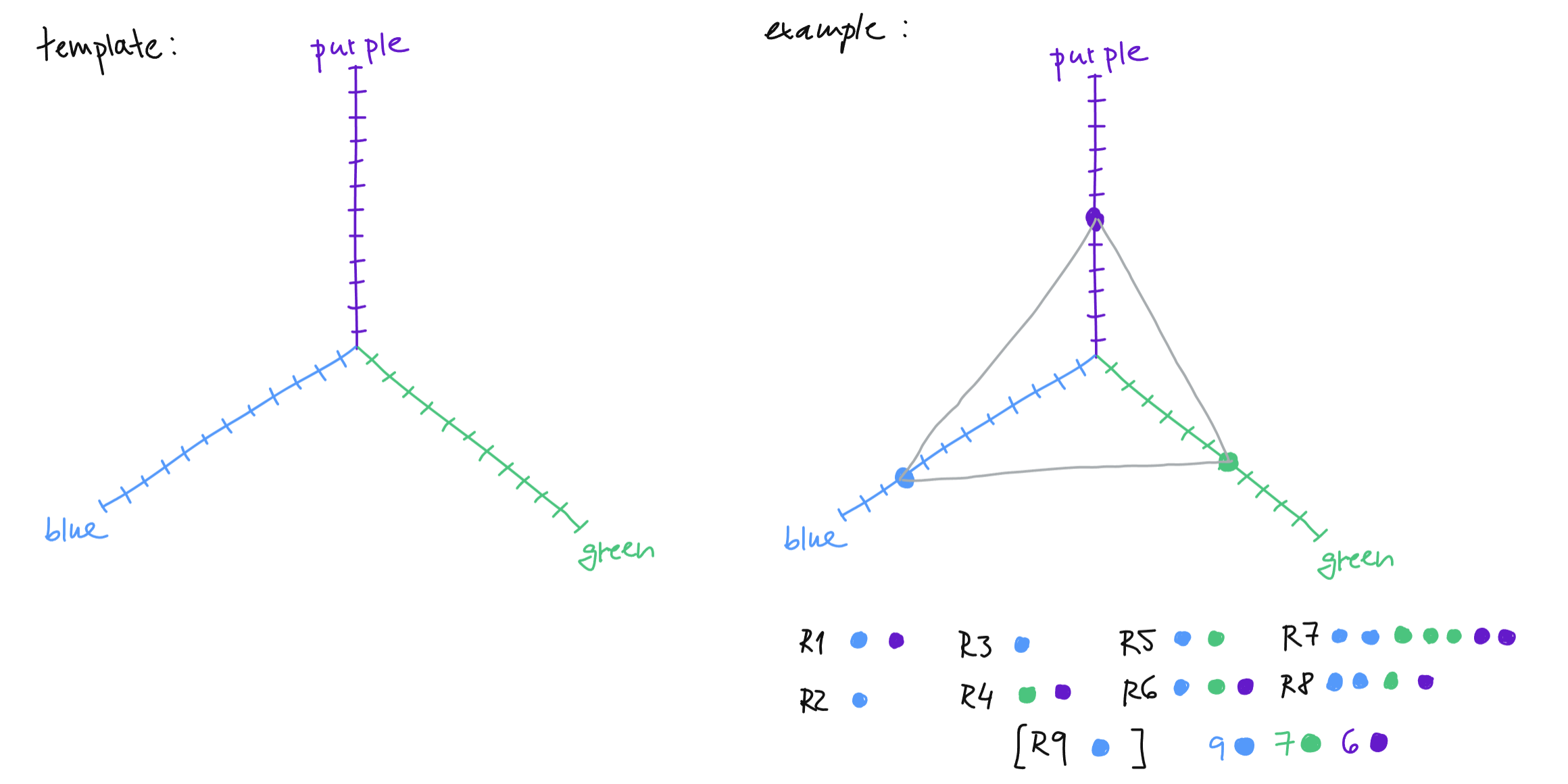
I’ve totally hand-drawn these, but on an online whiteboard rather than on paper (so it’s easier to show them clearly here). The example shows the choices and how they help construct the final triangle. Notice that I haven’t included the answer to Reflection 9 in the overall tally, and I’ve made it clear which reflection got what colours as I was answering (my example is completely made up, btw).
Step 1 — Observe Your Triangle
Your Learning Layers Triangle
You’ve now made your family’s maths story visible. Just notice for a moment: where does the "weight" of your triangle sit? The further a point sits from the centre, the stronger that "Pull" currently appears in your learning experience.
- Blue Axis — Knowledge Pull
- Green Axis — Practice Pull
- Purple Axis — Meaning Pull
This isn't a measure of success or failure. It's simply a visual representation of where your attention, effort and tension may currently be gathering. A "disproportionate" triangle doesn't mean you need to panic. Every triangle simply tells a different story. Our goal here isn't a "perfect" shape; it’s simply awareness.
Step 2 — Understand Your Strongest Pull
If more than one colour appears as a high score, feel free to read about both. As you read these descriptions, just notice which one resonates with your current "daily feel" of your maths journey.
🔵 If blue appears strongest...
This reflects what I call “The Builder” (Layer 1).
Your attention is naturally drawn toward the "what" of learning: resources, curriculum, finding the right explanation, or filling knowledge gaps. You might find yourself asking: "What should we use?" or "Have we found the right resource yet?"
It’s completely natural to start here, as this is the part of learning we can see and touch. But you might have noticed a curious pattern: sometimes, even when you find the "perfect" resource, something still feels slightly out of alignment, and you still feel that confidence, consistency or enjoyment are missing. It’s like having the best bricks in the world, but wondering why the house still feels a bit chilly. Often, that "chill" isn't about the bricks (the curriculum)—it's coming from somewhere deeper.
🟢 If green appears strongest…
This reflects what I call “The Navigator” (Layer 2).
Your focus is likely on the rhythm of learning: routines, consistency, and how to keep the momentum going. You might be asking: "Why can't we stay consistent?" or "Why does learning feel so stop-start?"
Rhythm is what gives learning its life, and it’s where most of our daily effort goes. But if you’ve ever felt like you’re "managing" the learning rather than enjoying it, you’re not alone. It often feels like trying to keep a boat on course—if you stop rowing for one second, you start to drift. When consistency feels like a constant effort, it’s usually a sign that something beneath the surface is creating a bit of invisible resistance.
🟣 If purple appears strongest…
This reflects what I call “The Framer” (Layer 3).
Your awareness is already drawn toward the "human" side of maths: confidence, resistance, and the relationship your learner has with the subject. You’re likely asking: "How do we get back to the joy of learning?" or "Why does confidence disappear so quickly?"
If this is your strongest pull, you’re already looking at the roots of the tree. You can sense that the "leaves" (the knowledge, the progress and visible outcomes) are being shaped by things we can't see—beliefs, emotions, and identity. This is the layer that most traditional maths resources assume is "just fine," yet it’s the one that determines whether everything else actually works.
We’re not often taught about this Layer; we may feel it naturally, we may sense its importance, but it tends to remain hidden, almost forgotten.
Step 3 (Don’t underestimate this one) — Look Beyond the Triangle
Before we move to the next part of the journey, I’d love for you to do one small thing that often reveals more than the triangle itself. Take a look back at your answers, but this time, look at them in these specific pairs:
R1 + R2: How you experience a challenge ↔ How you usually respond to it.
R3 + R4: What feels frustrating right now ↔ What you wish it felt like instead.
R5 + R6: Where you’re spending your energy ↔ The change that would actually matter most.
R7 + R8: What you feel responsible for ↔ What feels outside your control.
As you look at these pairs, just notice: do the colours match, or do they tell two different stories?
Neither is right nor wrong, but a "mismatch" is often where the most helpful discovery lives. For example, if your challenge is Purple (emotional weight) but your response is Blue (buying more resources), you might be trying to solve a Layer 3 problem with a Layer 1 tool.
It’s like trying to fix a leak in the basement by repainting the roof—it's a lot of hard work, but the floor is still wet, isn't it? These mismatches aren't mistakes; they are simply signals pointing us toward the layer that is truly asking for our attention.
Step 4 — An Invitation to the Roots
If you’ve made it this far, your triangle and your reflections have likely started highlighting a common thread. For some, there is a clear pull toward the visible—resources and routines. For others, the pull is toward the invisible—confidence, identity, and the "human" side of maths. But regardless of where your triangle leans, you’ve likely started to notice something you can't "unsee": learning isn't happening in just one layer.
This is why so many families find themselves doing everything “right” on the surface — the resources, the routines, the effort — and still feeling like something underneath is not quite shifting; have you noticed that too? It’s not because anything is wrong, but because one layer is often under-recognised in most traditional learning approaches: Layer 3 — the human layer, the layer of meaning, identity, and relationship with learning.
Even when we focus on the "Blue" of knowledge or the "Green" of practice, there is always a "Purple" influence in the background. The way learning feels—the confidence, the pressure, the curiosity, the doubt—is the soil that everything else grows in.
If you’re wondering why the "leaves" of your maths journey sometimes feel wilted despite all your hard work, I’m inviting you to come and look at the roots with me.
I created the Home Ed Maths Breakthrough Series specifically for this. It isn't a new curriculum or a set of worksheets. Instead, it’s a gentle, 18-part guided journey designed to help you understand the deeper forces shaping your maths experience—especially Layer 3, the layer that traditional resources usually leave you to figure out on your own.
Your journey begins with the free Maths Mountain Map. This is a simple reflection tool designed to help you visualise the landscape of your current experience more clearly. Once you have your map, we’ll move into the weekly series together, helping you slowly uncover the hidden influences that make maths feel heavy—until the path forward starts to feel lighter and more intentional.
Ready to continue? Start Your Home Ed Maths Breakthrough